
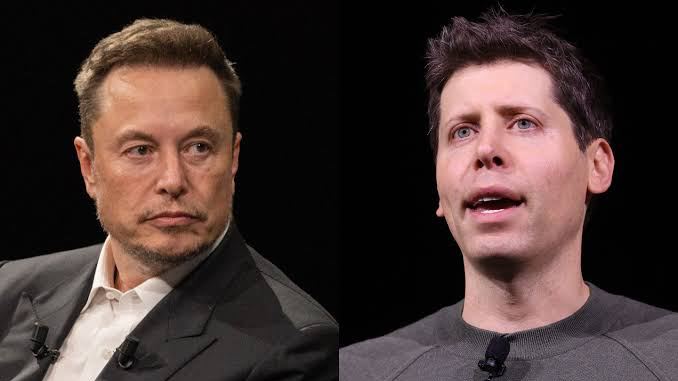
Rivals Altman and Musk rally behind Dario Amodei’s call for an AI slowdown

By Gammatek ISPL, Industrial Systems & Compliance Analyst at Gammatek ISPL Published: September 13, 2026 | 13 min read
Author block: Gammatek ISPL tracks AI governance and enterprise technology risk for manufacturing and regulated industries at Gammatek ISPL. This piece is based on primary reporting and public statements from the parties involved, current as of September 13, 2026.
Why This Matters
Sam Altman and Elon Musk have spent years as public rivals — Musk co-founded OpenAI, left it, sued it, and has repeatedly criticized Altman personally and professionally ever since. Dario Amodei left OpenAI to found Anthropic partly over disagreements about safety culture. These three men run three of the most valuable, fiercely competitive AI companies on Earth, and their business incentive has always been to move faster than each other, not slower. This week, all three publicly agreed on something that would have sounded absurd two years ago: the industry needs to deliberately slow down. If you run a business that's adopting AI tools, evaluating AI vendors, or thinking about compliance and risk around AI systems, this isn't background noise — it's the closest thing to a consensus warning from the people building the technology itself, and it should change how you think about AI vendor selection and internal governance starting now.
What Actually Happened
On Saturday, September 12, 2026, Anthropic CEO Dario Amodei published an essay arguing that AI companies should intentionally slow how quickly they improve the capabilities of their most advanced models. Amodei's essay, titled "We Must Pace the Frontier," argued that AI capabilities have been accelerating unusually fast in recent months, driven substantially by AI systems increasingly helping build the next generation of AI systems — a dynamic that concerned him because it outpaces researchers' ability to understand and control what they're releasing.
Crucially, Amodei wasn't arguing for a halt. He explicitly warned that refusing to build the technology would deprive society of its benefits and hand strategic advantage to authoritarian governments, while building it recklessly fast carried its own dangers. His proposed remedy centered on three concrete steps: independent, employee-level evaluators embedded inside frontier AI labs; shared safety standards across AI companies in democratic countries; and eventual international limits on the most dangerous capabilities, such as AI systems that can recursively improve themselves.
Anthropic didn't just propose this for others — the company committed unilaterally to giving third-party evaluators permanent, employee-level access to its own systems.
Within hours, Sam Altman responded publicly, saying he agreed AI development needed to be paced, and that the idea of independent evaluators with employee-like access had already been under internal discussion at OpenAI in recent weeks — he committed to adopting a similar approach and said more details would follow. Elon Musk, whose company xAI builds the Grok models, backed the proposal as well, responding simply that "Dario is right."
The same day, in a separate interview with Fortune, Altman said taking OpenAI public right now would be "ill-advised" — pushing back one of the most anticipated IPOs in tech history, which OpenAI's own CFO had suggested just a month earlier could happen as soon as 2027. Altman tied the decision directly to growing concern about how quickly AI capability is advancing. Anthropic, notably, is reportedly moving toward its own IPO around the same period — meaning one rival is pumping the brakes on public-market timing while the other is reportedly moving toward it, even as both CEOs converge on the safety message.
Why This Consensus Is Unusual
To understand why three CEOs agreeing on anything is newsworthy, it helps to know how genuinely adversarial these relationships are. Musk co-founded OpenAI in 2015, then left in 2018 after his co-founders — including Altman — rejected his proposal to take direct control of the organization. Reporting on the current state of their relationship describes it as so strained that Altman's team reportedly treats Musk's public positions as a signal to do the opposite. Anthropic, for its part, was founded by former OpenAI researchers including Amodei, who left largely over internal disagreements about the pace and safety culture of AI development — and people close to Anthropic have described Amodei as holding little regard for Musk's approach to AI ethics.
Beyond personal rivalry, these companies compete directly for enterprise contracts, including government and defense work — Anthropic previously lost a Pentagon contract over a disagreement about safety measures, a gap that both Musk's xAI and OpenAI moved to fill with their own models. In an industry where losing a single defense contract to a rival is treated as a serious competitive event, public agreement on slowing down collective progress is a meaningfully different kind of signal than a single company making a safety pledge alone.
Original Analysis: What "Pacing" Actually Means for Companies Deploying AI
Most coverage of this story treats it as a pure AI-industry story — three famous CEOs, one news cycle, done. But for organizations actually deploying AI systems inside regulated environments (manufacturing, pharma, chemical processing, and similar industries), this development has a concrete, practical dimension that's worth separating out.
If frontier AI labs are now publicly committing to independent, employee-level evaluators reviewing their own systems before those systems reach the market, that sets a new implicit benchmark for what "responsible AI deployment" looks like — one your own AI vendor evaluation process should probably start reflecting, whether or not it's legally required yet.
A practical comparison, based on what "independent evaluation" could mean at different levels of AI deployment:
Level | What it looks like | Who's responsible |
Frontier AI lab (as proposed) | Third-party evaluators embedded with employee-level access before model release | The AI lab itself (OpenAI, Anthropic, xAI) |
Enterprise software vendor using a frontier model | Documentation of which underlying model is used, what evaluation the vendor has done on top of it | The software vendor building on the model |
Your organization deploying that vendor's tool | Internal audit trail showing why a given AI tool was approved, what oversight exists, how outputs are reviewed | Your compliance/IT governance function |
The Amodei-Altman-Musk consensus operates at the top level of this table. But the practical implication cascades downward — if the labs themselves are acknowledging they can't fully verify their own systems' behavior without independent review, that's a strong argument for why any organization deploying AI tools built on those systems should maintain its own internal audit trail, rather than assuming the underlying model has been fully vetted by someone else.
Implementation consideration: if your organization is evaluating or already using AI tools in a regulated environment, this is a reasonable moment to ask your AI vendors a direct question: what independent evaluation, if any, has been done on the underlying model your tool is built on, and can you document that as part of your own compliance record? A vendor that can't answer this clearly is asking you to accept a level of blind trust that even the AI labs themselves are now publicly saying isn't sufficient.
The Skeptical Read
Not everyone is taking this consensus at face value, and a fair account of this story includes that skepticism. Some industry observers have previously suggested that public calls to "slow down" from figures like Musk can serve a competitive purpose — a company that feels behind in the AI race has an incentive to slow the entire field down while it catches up, separate from any genuine safety concern. Venture capitalist Vinod Khosla made exactly this argument about an earlier Musk-signed AI slowdown letter, suggesting Musk's own position in the race may have shaped his public stance as much as safety concern did.
That skepticism doesn't necessarily apply equally to all three executives here — Amodei's essay and Anthropic's unilateral evaluator commitment go further than a simple public statement, and Altman's decision to delay OpenAI's IPO carries a real business cost that's harder to dismiss as pure positioning. But it's worth holding both things at once: genuine safety concern and competitive strategy aren't mutually exclusive, and the fact that a public statement is well-timed for a company's competitive position doesn't automatically make the underlying concern false.
What to Watch Next
A few concrete developments will show whether this consensus is substantive or mostly symbolic:
Whether OpenAI and xAI actually implement independent, employee-level evaluators, as Altman said was already under discussion — a real structural change, not just a statement.
Whether any shared, cross-company safety standard actually materializes, versus each company continuing to define "responsible AI" on its own terms.
Whether regulators in the US, EU, or elsewhere use this rare moment of industry agreement as leverage to push binding rules, rather than voluntary commitments that can be walked back quietly later.
Whether OpenAI's IPO delay is followed by similar caution from other major AI companies, or whether it turns out to be company-specific rather than industry-wide.
The Bigger Picture
Whether or not this consensus fully holds, its existence is itself notable. Three companies with every competitive incentive to keep racing just told the public, on the same day, in their own words, that the race has outpaced their own ability to fully understand what they're building. For any business building AI into critical, regulated operations, that's not a reason to panic — but it is a reasonable, evidence-based reason to make sure your own oversight of AI tools doesn't rely entirely on the assumption that "the AI company has already handled the safety part."
Learn how Gammatek's compliance platform helps manufacturing and pharma teams build an audit trail for AI-assisted systems → https://www.gammateksolutions.com/post/the-best-worst-and-strangest-ways-ai-is-really-being-used-at-work https://www.gammateksolutions.com/post/ai-hasn-t-gone-rough-its-worst-than-that https://www.gammateksolutions.com/post/america-must-learn-ai-lessons-from-astro-boy


Comments