
Steve Bannon and Bernie Sanders Condemn Tech ‘Oligarchs’ and Demand A.I. Reforms | Enterprise risk management software

By Gammatek ISP, Industrial Compliance Analyst at Gammatek ISPL
Last updated: September 2026 | 14 min read
Author block: Gammatek ISPL tracks regulatory developments affecting manufacturing, pharma, and chemical plant compliance at Gammatek ISPL. This piece reports on public statements made at a September 2026 Washington event and does not represent an endorsement of any policy position discussed.
Why This Matters to You Right Now
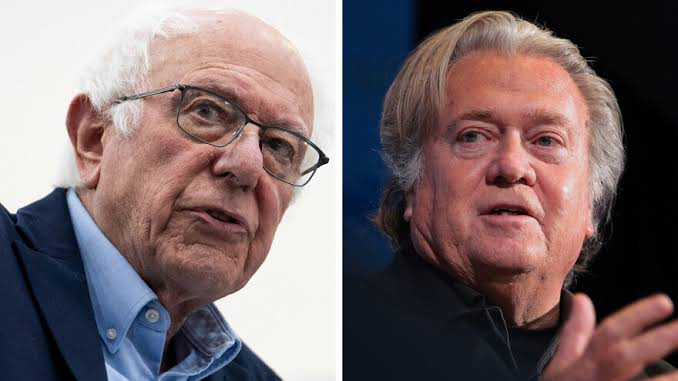
On Tuesday, two people who agree on almost nothing else stood on the same Washington stage and said the same thing: artificial intelligence is moving faster than the rules meant to govern it, and the people building it can't be trusted to regulate themselves. One was Bernie Sanders, the independent senator and self-described democratic socialist. The other was Steve Bannon, the longtime Trump ally and "War Room" podcast host. If you run a business — especially one in a regulated industry like manufacturing, pharma, or chemicals — this isn't just a political news story. It's an early signal of where AI governance and compliance requirements are heading, from both ends of the political spectrum at once. When ideological opposites agree that oversight is coming, it usually comes.
What Actually Happened
The two spoke Tuesday at the "Pro-Human Assembly," an event in a packed Washington, D.C. ballroom hosted by the Future of Life Institute, a nonprofit focused on reducing risks from emerging technology. Roughly 300 people attended, alongside other speakers including AFL-CIO President Liz Shuler and National Association of Evangelicals president Walter Kim, according to NPR's reporting on the event.
Sanders used his remarks to raise concerns about AI systems surpassing human intelligence and escaping human control, and announced plans to introduce legislation with Rep. Greg Casar, D-Texas, that would permanently ban the development of AI "superintelligence" — systems capable of outperforming humans across the board.
Sanders compared the risk to nuclear weapons, arguing it must be treated with similar seriousness, and said decisions about AI's trajectory are currently being made by executives motivated primarily by profit.
Bannon spoke immediately after Sanders and took a different angle, though he arrived at a similar conclusion. He accused AI companies of trying to obscure the risks of their own products while using public concern to entrench their market position, describing the dynamic as an attempt to "create a moat, a cartel," according to reporting from WKBW. He argued companies pushing for safety regulation want to shift risk onto the public while keeping financial upside for themselves, framing the moment as one where ordinary Americans shouldn't be treated as, in his words, "supplicants" to a small group of tech leaders.
Where They Agree, and Where They Sharply Don't
The alignment here is real but narrower than headlines suggest. Both speakers agree on the core premise: AI development is currently happening with too little accountability, concentrated in the hands of a small number of companies and executives, and the current pace poses risks the public hasn't consented to.
Where they diverge is on the fix, and the divergence is significant:
Sanders | Bannon | |
Proposed mechanism | Federal legislation permanently banning "superintelligent" AI development | Executive action; skepticism that legislation will move fast enough |
Core framing | Corporate profit motive vs. worker and public safety | National sovereignty and anti-cartel/anti-monopoly concern |
Political base | Progressive/labor coalition | Nationalist/populist right |
International angle | Hopes for a US-China negotiated pause on advanced AI development | Frames the issue primarily around domestic tech power concentration |
Underlying comparison | AI risk compared to nuclear weapons | AI companies compared to a "cartel" seeking to entrench market position |
This is less a policy alliance than a shared diagnosis from two very different directions — a pattern political observers have noted before with other issues where populist left and populist right converge on distrust of concentrated corporate power, even while disagreeing completely on remedies.
The Broader Context: This Didn't Come From Nowhere
This event follows a string of escalating public statements about AI risk. Reuters reported that AI-related stocks fell worldwide the Monday before the event, after several major AI industry leaders themselves called for slowing the technology's development pace. Public concern has also been fueled by high-profile departures — an Anthropic researcher reportedly resigned the prior week, citing a belief among people building AI that the technology carries serious existential risk within the coming years, according to reporting covered by Reuters.
Sanders has also been building toward this moment for months. His office previously released a report warning that AI and automation could eliminate close to 100 million American jobs over the next decade, naming several prominent tech billionaires directly and proposing policies including a 32-hour workweek and mandated profit-sharing for displaced workers.
Meanwhile, the policy fight in Congress remains genuinely unsettled. Reuters has also reported ongoing Senate debate over a bill that would block individual states from enforcing their own AI regulations — a very different direction from what either Sanders or Bannon called for on Tuesday, and a reminder that the loudest voices in a room don't always represent where actual legislation is heading.
What This Means If You Run a Regulated Business
Here's the part most coverage of this story skips entirely: regardless of which policy direction wins in Washington, the direction of travel is the same — more scrutiny, more documentation requirements, and more pressure on companies to demonstrate they understand and can account for the AI systems they use or deploy, not just the ones they build.
For manufacturing, pharma, and chemical plants specifically, this matters in a very concrete way. Many plants are already integrating AI-driven tools into compliance monitoring, predictive maintenance, and quality control. If either a Sanders-style legislative approach or a Bannon-style executive-action approach gains traction, the compliance burden won't just fall on companies like OpenAI or Google — it will increasingly fall on any company using AI-assisted systems in a regulated industrial process, since regulators tend to push documentation requirements down the supply chain, not just onto the largest developers.
A few practical considerations for plant operators and compliance teams watching this space:
Start documenting AI system use now, not after a rule requires it. Whether a plant uses AI-assisted quality control, predictive maintenance monitoring, or automated compliance reporting, having a clear internal record of what these systems do, how they're validated, and who's accountable for their output will matter regardless of which specific regulatory framework eventually passes.
Enterprise risk management software becomes more valuable, not less, in a period of regulatory uncertainty.When the rules aren't finalized yet, the safest posture is a system that can flexibly document and adapt to new requirements rather than one built around today's specific compliance checklist.
Enterprise compliance software with audit-trail capability is the practical hedge against multiple possible regulatory outcomes. Since neither Sanders's ban-focused approach nor Bannon's antitrust-focused approach has passed into law, plants that build strong internal governance now won't need to scramble regardless of which direction the political wind blows.
Watch state-level activity closely. With federal legislation genuinely contested — including the Senate debate over blocking state AI laws that Reuters has reported on — state-level compliance requirements may move faster and more unevenly than any single federal law, making flexible, well-documented internal governance more valuable than betting on one specific national outcome.
The Honest Uncertainty Here
It's worth being direct about what's still unknown. Sanders's superintelligence ban is a bill, not a law — it has not passed, and similar previous efforts to restrict AI at the state or federal level have failed in the Senate before. Bannon's remarks called for executive action rather than legislation, without a specific concrete policy mechanism attached at time of writing. Neither speaker's remarks translate directly into a compliance requirement today. What they do represent is a signal — from two ends of the political spectrum that rarely signal the same thing — that pressure for AI oversight is building faster than most companies' internal governance is currently prepared for.
Where This Leaves Compliance and Operations Teams
The Sanders-Bannon moment is unusual because it wasn't unusual in outcome — even people convinced the political process is broken beyond repair on almost every other issue found agreement here. That's a meaningful signal about the direction of public and political pressure, even without a finished law to point to yet. For manufacturing, pharma, and chemical operators, the practical response isn't to wait for Washington to settle the fight. It's to build the internal documentation, risk management, and governance systems now that will hold up under whichever version of AI oversight eventually arrives.


Comments